Introduction
I. Introduction
With the evolution of aeronautical systems towards composite structures, electromagnetic simulation is becoming more complex. These composite structures impose more diffuse current return paths. This configuration makes coupling phenomena less easy to anticipate and accentuates the importance of fine modelling of 3D/1D interactions.
Before going any further, let’s take a look to the two hybridisation or coupling approaches available:
- Unidirectional coupling (AXS-E3) , which has been used historically, is based on sequential coupling between a 3D solver and a 1D solver. Electric fields are first calculated in the 3D environment, then injected into the cabling model (transmission line).
- Bi-directional coupling (AXS-EMC), a new feature of this version, enables bi-directional interaction between the two solvers at each time step. This approach takes better account of coupling phenomena between the structure and the cabling.
This is the background to our test case, designed to illustrate the advantages of bidirectional coupling. It consists of the three interconnected boxes with a cable harness inside, simulating the conditions encountered in modern aircraft.
In the continuation of this article, we study four variants for modelling this test case, combining different types of hybridisation (unidirectional / bidirectional) and line modelling (single conductor / multi conductor), in order to assess the benefit and relevance in relation to a reference case.
II. Presentation of the test case:
The case study represents a realistic scenario inspired by the electric architectures on board modern aircraft with composite structures. It is entitled NTC2 and comes from a model in the EPICEA project, a study led by ONERA in collaboration with AxesSim, Fokker, Bombardier Aviation, Polytechnique de Montréal, IDS, ARTTIC SAS, SOLUTIONS ISONEO and Ecole de Technologie Supérieure.
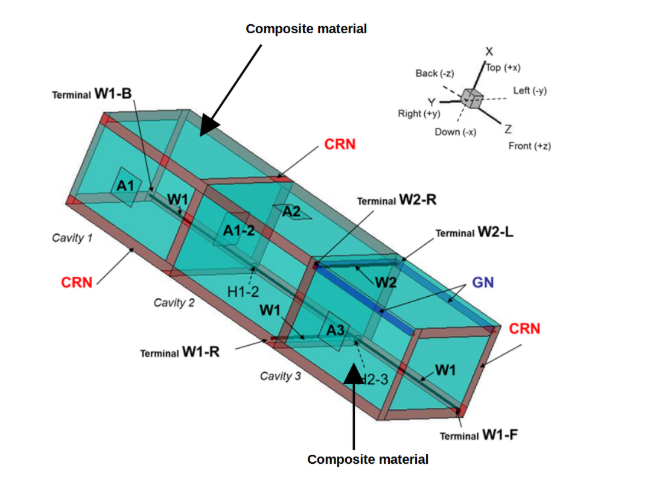
It consists of three cavities which are interconnected through square openings through which the wiring harnesses pass.
The case study includes two types of current return network as observed on actual aircraft.
-
- A Current Return Network (CRN) designed to conduct lightning currents. It extends across different edges of the system and is integrated into the external face surfaces.
- A Ground Network(GN) designed for current return due to the electrical system. It runs along three edges of the third cavity and is connected to the CRN network at a certain height.
- The rest of the geometry is made up of composite structures.
This model simulates situations where the return path is not immediate, a typical configuration in modern aircraft, where the absence of metallic continuity can complicate current return paths.
An illustration of the model’s geometry is shown below:
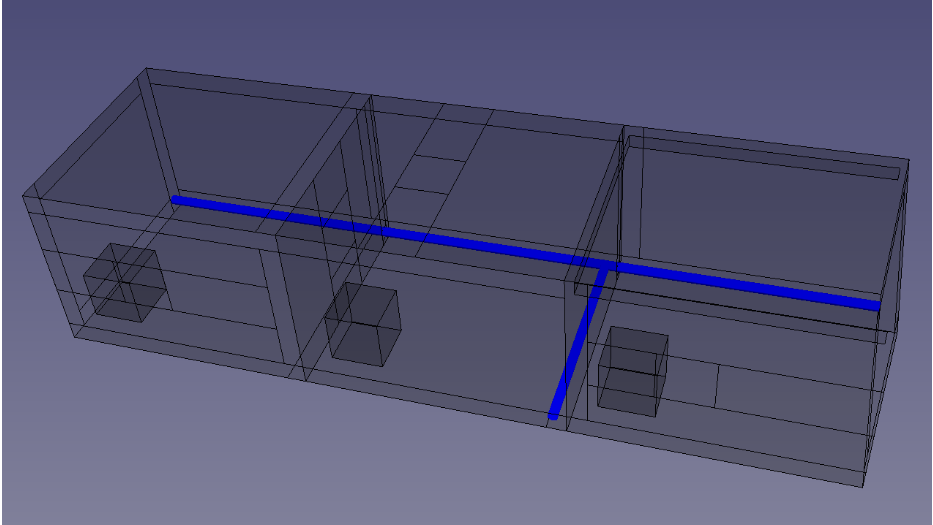
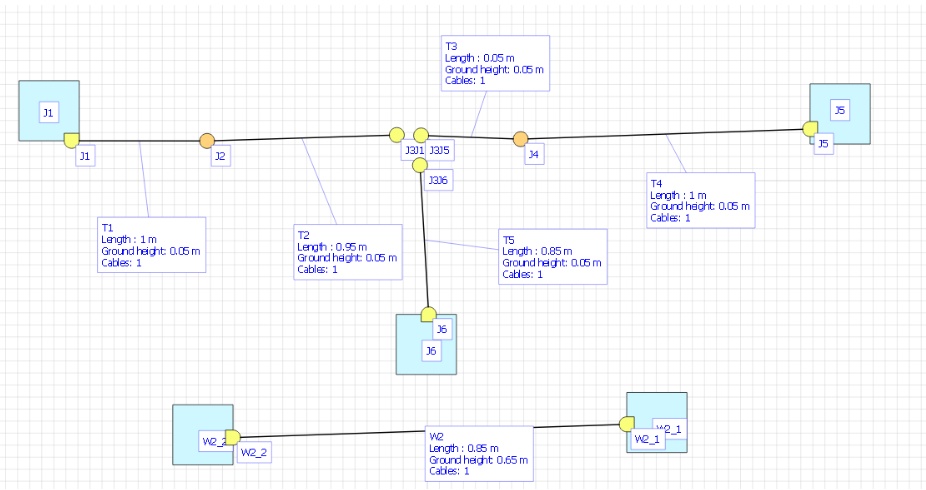
These are two cable paths in the NTC2. The first is W1 (in blue in the following figure). This is a T-shaped network that passes through the three cavities. It is illustrated in the following figure:
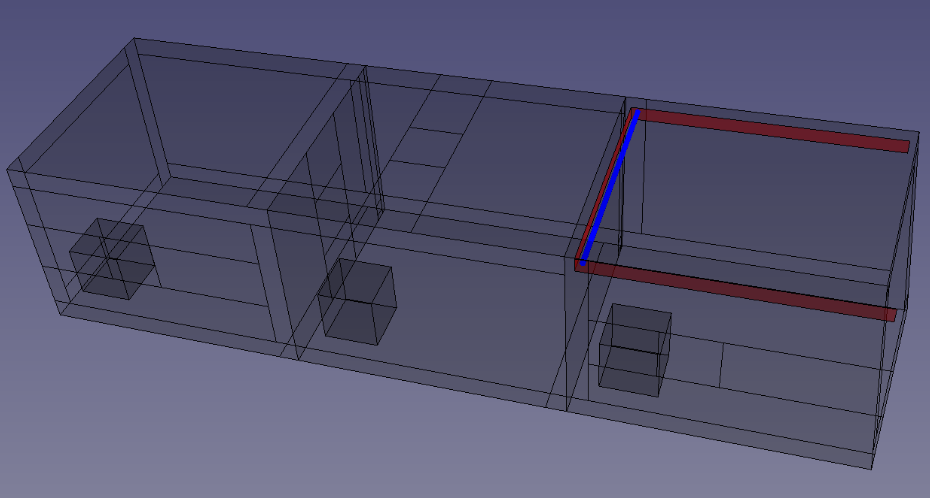
- The second is W2 which is located in cavity 3 and is above the GN network (in red).
This test case highlights the specific challenges posed by composite structures:
-
-
- current return path
- the contribution of bidirectional coupling to take these complex interactions into account.
-
Wiring harness description
Different types of cable structures are used in the network:
-
-
- single wires
- cable pairs
- coaxial cables
- shielded pairs
- over-shield
-

III.Methodology :
To assess the impact of the new features, four simulations scenarios have been configured, combining two main parameters:
-
- Type of coupling : unidirectional vs bidirectional
- configuration : single and multi-conductor
1. Tools used
The following tools are used:
-
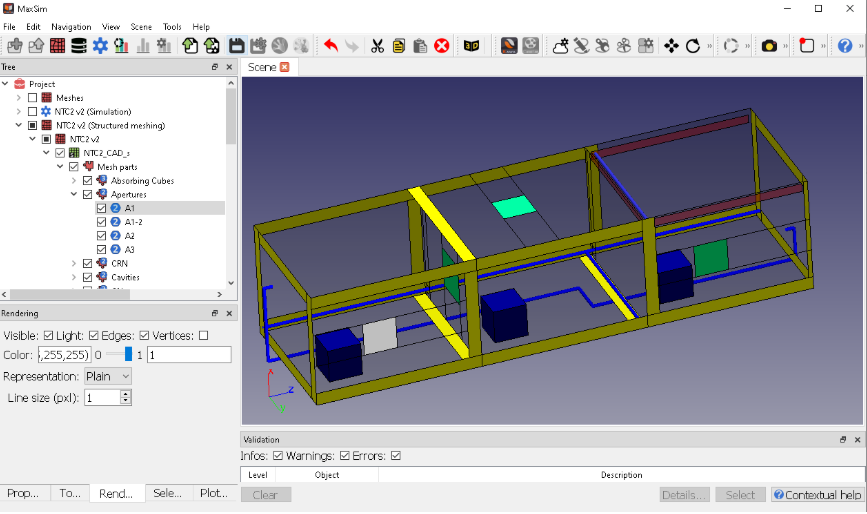
- FreeCAD for the geometry of the model
- FDTD simulation pre-processing and editing tool : MaxSim
Cable bundles are in blue, openings in green (except A1 in white) , the CRN network in yellow and the GN network in red.
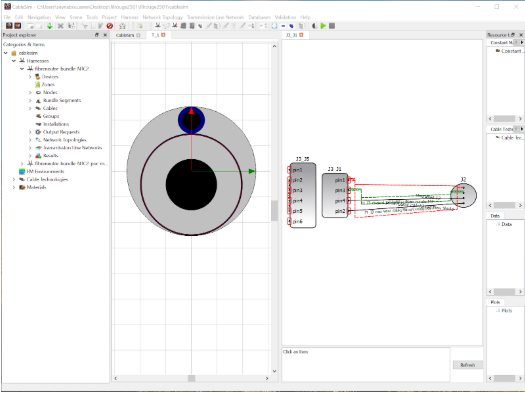
Wiring harness definition tool : Cablesim
The harness can be viewed in a graphic editor: the canvas 2D illustrated by the following image:
-
- Transmission line calculation tool Milo
- The FDTD simulator (in cooperation with Xlim) Tesmi-FD
- The Kawa post-processing and results visualisation tool
Everything is orchestrated via the common project, which centralises data and facilitates exchanges (cable routes, simulation results, etc.) between the various tools, and therefore the implementation of hybrid test cases.
The illustration below shows the tree structure of a common project integrating the MaxSim, Cablesim and Kawa tools.
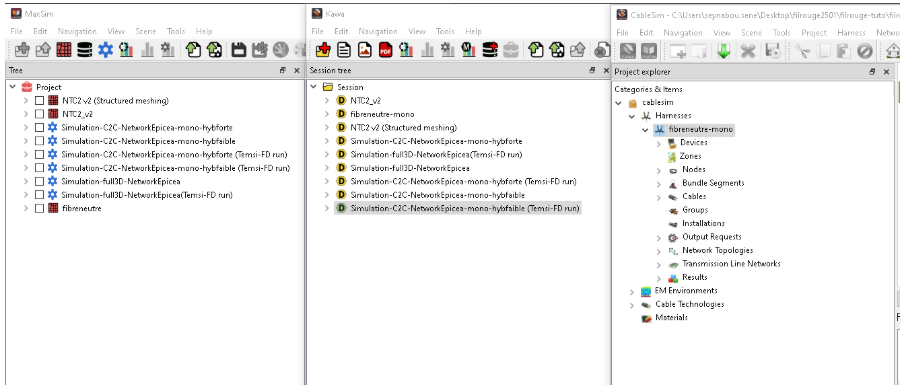
The illustration above shows the MTLN model in MaxSim. This model contains the Milo MTLN network and can be viewed in the 3D view.

2. Source configuration
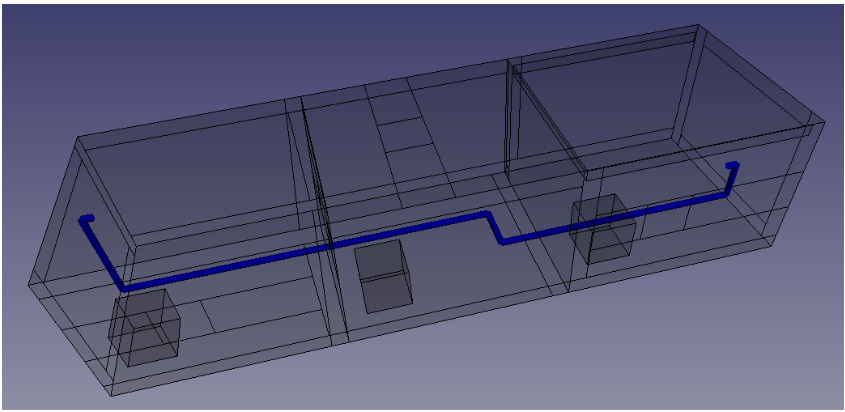
The conductor W3 (outside the cavity) is used to inject current into the test object. The W3 wiring path (in blue) is shown in the following figure :
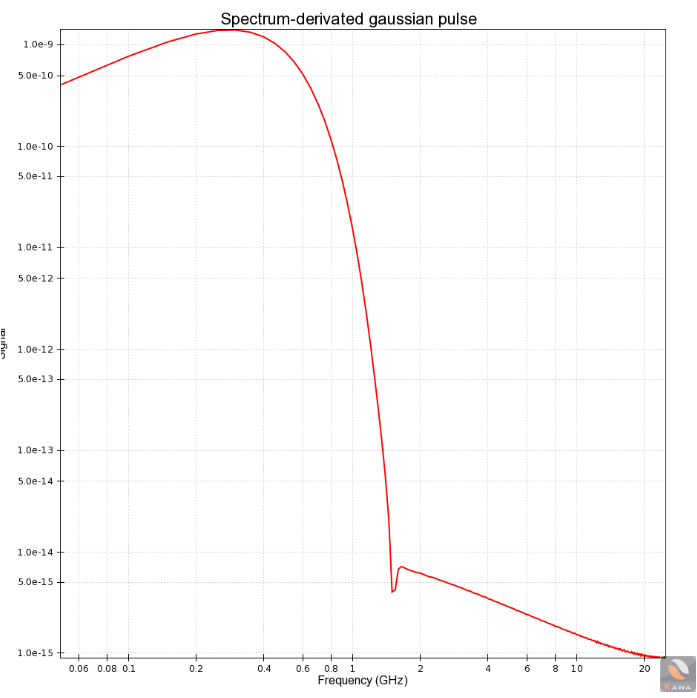
The waveform of the source is as follows. On the right we have the spectrum of the source and on the left the time formula.

IV.Results :
The aim of this study is to compare the results obtained for the following four scenarios:
-
- Two types of coupling : unidirectional vs bidirectional
- Two cabling configurations : single conductor vs multi-conductor.
The raw results are in the time domain, but a Fourier transform has been applied to represent the signals in the frequency domain.
The output requests are as follows :
-
- Tangential electric fields in the cable paths. These electric fields will be injected into the transmission line in the case of unidirectional coupling.
- Electric and magnetic fields in cavities 1,2 and 3 in the context of unidirectional and bidirectional couplings
- The currents and voltages at the ends of the wiring harnesses (single and multi-conductor) for unidirectional and bidirectional couplings.
1. Single-conductor configuration
The single-conductor configuration was chosen as the starting point because it allows direct comparison with the reference simulation processed entirely in FDTD using the Temsi-FD oblique wire model.
Below we plot the waveform and spectrum of the current at the end of cable W1 located in cavity 1.
-
- The full Temsi-FD reference simulation in red;
- The simulation with bidirectional coupling in green;
- The simulation with unidirectional coupling in blue.
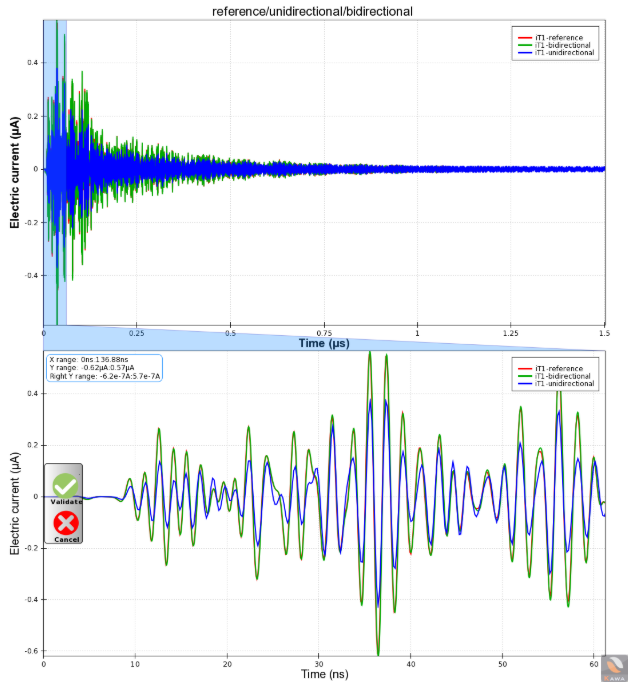
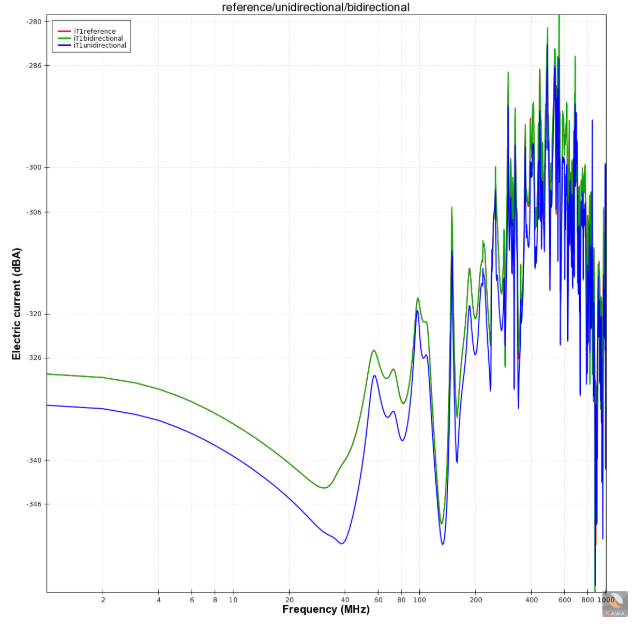
We can see that the bidirectional coupling overlaps with the reference simulation in both amplitude and waveform.
However, unidirectional coupling shows a fairly significant deviation from the reference, even at low frequencies.
These differences can be explained by the idealised consideration of common-mode current return in the case of unidirectional coupling.
This first comparison validates the bidirectional coupling and justifies the interest of this method. The single-conductor configuration allows validation against the full 3D (reference simulation).
2. Multiconductor configuration
First, we will visualise the electric fields in the cavities, then the end currents in the wiring.
- Electric field in cavities : comparison between bidirectional and unidirectional coupling in cavity 3
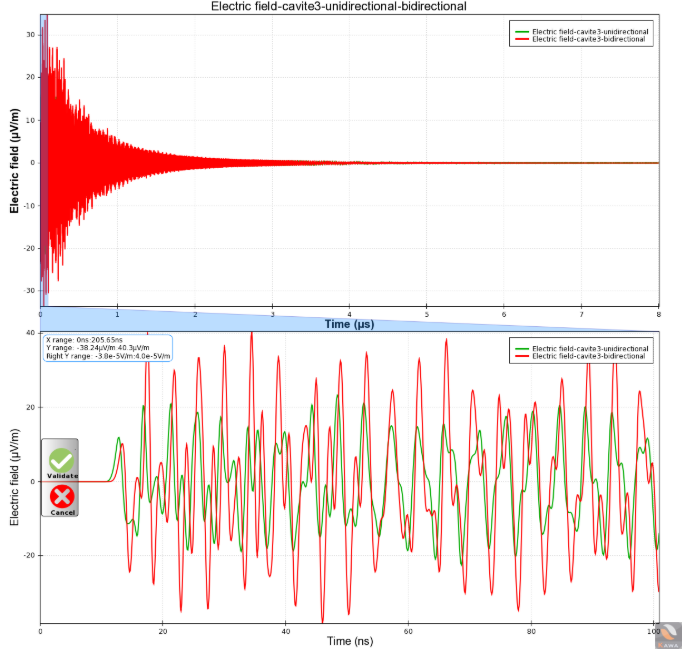
The comparison between unidirectional and bidirectional coupling shows a higher field amplitude in the case of bidirectional coupling.
- In bidirectional coupling, the conductors are modelled in the 3D solver as wires coupled to the FDTD network. The current flowing through them generates a field, which propagates in the cavity and is taken into account.
- Conversely, in the case of unidirectional coupling, the incident field is collected at the cable path and injected into a 1D solver. There is therefore no feedback from the current on the 3D field, and the radiation from the conductors is not taken into account.
As a result, a vector for energy transfer by current conduction on the W1 harness between the cavities is neglected in unidirectional coupling, which explains the discrepancies observed between the two methods and highlights the importance of bidirectional coupling.
In order to understand the coupling mechanisms at work in this study, we will calculate the skin depth. The formula for skin depth is as follows:

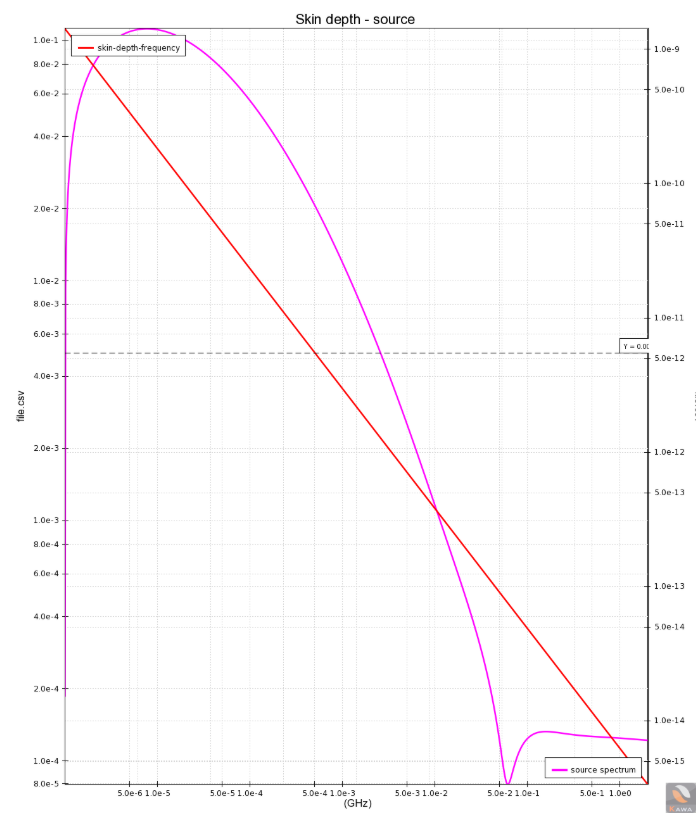
We can see that up to 500 kHz, the skin depth is greater than the plate thickness (5 mm). Up to this frequency, the EM field can penetrate by diffusion through the cavity walls. However, by viewing the source spectrum, we can see that its energy content in this band is low.
Above 500 kHz, the skin depth becomes less than the plate thickness and diffraction of the field by the openings then becomes predominant.
-
- Currents at the extremities
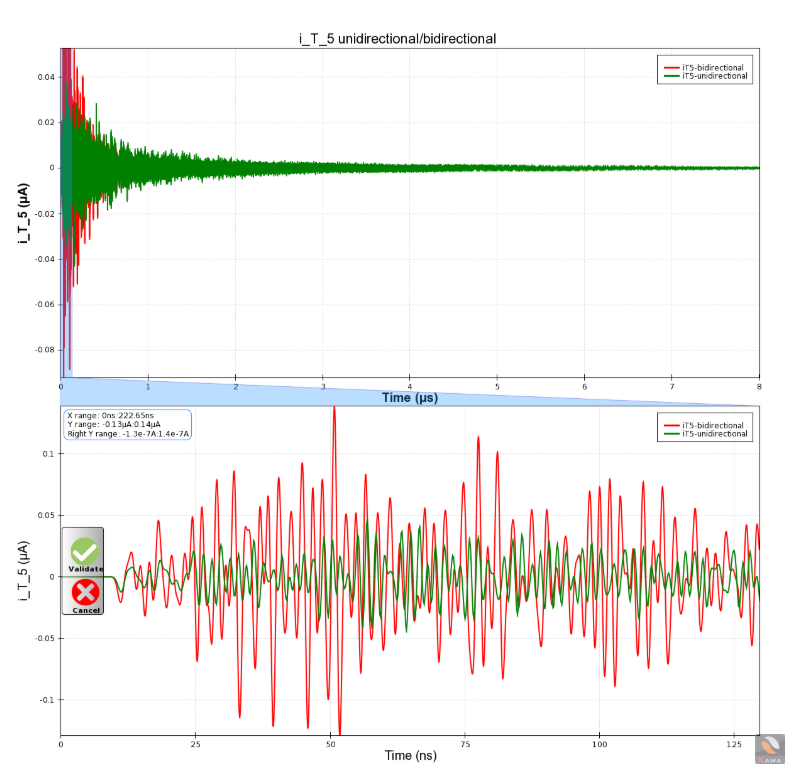
In cavity 2, which is further away from the source, we observe that the current measured at the end of the wire is significantly higher in the case of bidirectional coupling than in the case of unidirectional coupling.
Bidirectional coupling allows electromagnetic fields generated by currents flowing through wires to interact with the 3D environment (and vice versa). This makes it possible to take into account currents induced by field reflections or complex interactions between cables and metal structures.
Conversely, unidirectional coupling is limited to interaction between fields generated by the 3D simulation and projected onto the 1D transmission lines. The effects of current feedback on the environment are not modelled.
This leads to an underestimation of certain physical effects, particularly in cavities far from the source, as in the present case.
V. Conclusion
The study conducted on a test case inspired by the composite aircraft environment highlights the concrete benefits brought about by the introduction of bidirectional 3D/1D hybridization in the AxesSim software suite, as well as by the new common project concept.
The results show that bidirectional coupling allows for better consideration of complex electromagnetic interactions between structures and cabling :
-
- It reproduces physical effects that unidirectional coupling cannot capture, particularly in configurations with composite structures where common-mode current return paths are not direct
- In certain areas, the current calculated with unidirectional coupling is significantly lower than that obtained with a reference simulation or bidirectional coupling. This may present a risk of undersizing equipment’resistance, which could compromise its resistance to actual electromagnetic stresses
In an industrial context where the safety of embedded electronic systems is critical, particularly in aeronautics, it is essential to rely on reliable simulation methods. Bidirectional hybridisation thus increases the robustness of assessments made by numerical simulation.